Thermal Interface Materials
PCM — Phase Change Material
Solid at rest, softening under heat to fill every gap with a thin, reliable bond line.
Solid at rest, softening under heat to fill every gap with a thin, reliable bond line.
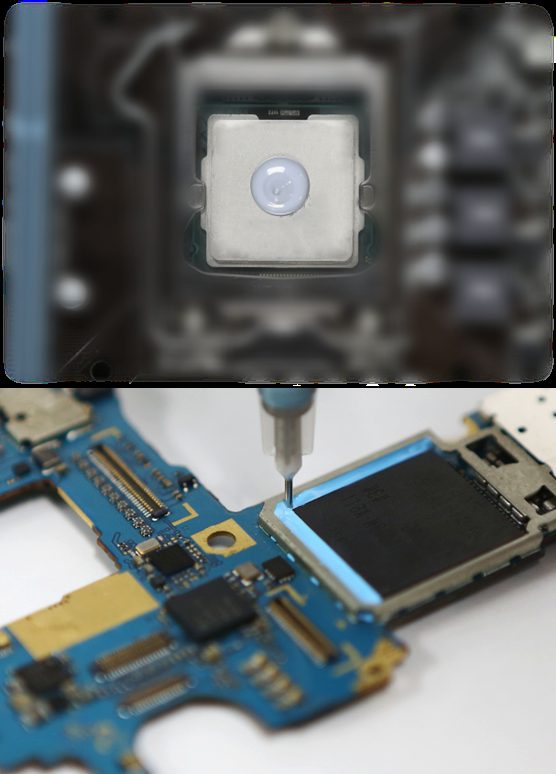
Phase-change materials are solid at room temperature and soften when heated, fully wetting both contact surfaces to deliver a thin bond line and high reliability without the pump-out problems of greases. The energy absorbed at phase transition is far higher than sensible heat, making PCM ideal where contact pressure and surface flatness vary.
| Property | Detail |
|---|---|
| State at room temperature | Solid |
| Behavior under heat | Softens, conforms to surface topography |
| Bond-line quality | Thin, high-reliability, no pump-out |
| Characterization | TGA (mass vs temperature) · DSC (heat flow) |
| Use case | Variable-pressure, variable-flatness interfaces |
CPU / GPU thermal interfaces
Power electronics
High-reliability assemblies
Interfaces with surface-flatness variation
Send us your application and target specs. Our engineers will match a grade and come back with a quote.